Home · Grow
Growing
How to grow garlic
A sunny, free-draining bed, named cloves, and a winter cold enough to split a bulb.
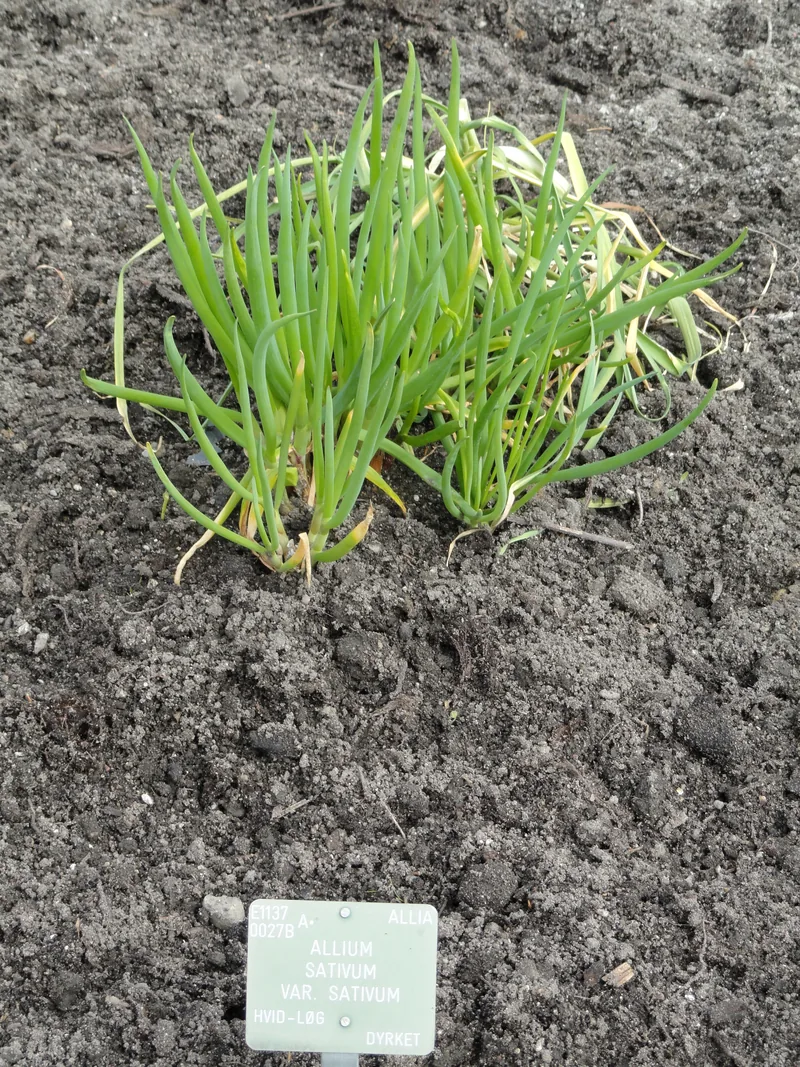
The RHS calls garlic a member of the onion family, and a staple of Mediterranean cooking, simple to grow in a warm sunny site with well-drained soil. [RHS] Cloves for planting, the RHS says, should be named varieties bought from a garden centre or mail-order supplier. It is not recommended to plant garlic bought from the supermarket, which may be unsuitable for the British climate and carries a risk of introducing disease. [RHS] Before planting, the RHS says to apply about two bucketfuls of well-rotted (not fresh) manure or homemade garden compost every square metre or yard, on a sunny site with free-draining soil. [RHS] Garlic is usually planted from mid-autumn to early winter, the RHS says, because most varieties need one to two months at 0–10°C (32–50°F) for good bulb development. Some varieties are suitable for planting in late winter and early spring. [RHS] Plant cloves the right way up, with the flat end downwards and the pointed end upwards, 15 cm (6 in) apart, with the tip 2.5 cm (1 in) below the soil surface, and with rows 30 cm (1 ft) apart. [RHS]
Heavy soil, modules and pots
If the soil is heavy or wet over winter, the RHS advises starting cloves in modules in autumn, keeping them in an unheated greenhouse, a cold frame or a sheltered outdoor spot, then planting them out in spring, 15 cm apart. [RHS] Garlic can be grown in a container; pots should be at least 25 cm (10 in) deep, at the same spacing and depth as in the ground. [RHS]
Care through spring
To improve bulb size, water during dry spells in spring and early summer, the RHS says, but do not water once the bulbs are large and well formed, and try to avoid wetting the leaves. [RHS] Remove any flower stems as soon as they start to form, the RHS says, or the plant’s energy goes into the flower rather than swelling the bulb, and the bulb will not store well. If picked young, while the flower is still in bud, the flower stalks (scapes) can be cooked. [RHS]
Pests and problems
The RHS plant profile rates Allium sativum as hardiness H4, and says it may be susceptible to allium leaf miner and onion fly, and to onion white rot, onion downy mildew and leek rust. [RHS] Bulbs that do not divide into cloves are usually the result of insufficient cold weather over winter, the RHS says. Split bulbs can happen if the crop was harvested late. Green cloves are usually due to shallow planting: they can be used as normal, but are unlikely to store well. [RHS] Cloves that form on the stalk, known as “top sets”, are usually due to changeable or fluctuating temperatures in spring, and can be used as you would ordinary cloves. [RHS] The RHS plant profile places garlic in the family Amaryllidaceae, and says to propagate it by dividing the bulb into cloves. [RHS]
When the leaves turn yellow, it is time to lift, cure and store.