Home · The garlic year
The year
The garlic year
Eight stages, one crop. Choose a stage on the desk; the table underneath keeps the same figures in view.
The RHS calls garlic a member of the onion family, and a staple of Mediterranean cooking, simple to grow in a warm sunny site with well-drained soil. [RHS] It is started from cloves rather than seed, the RHS says, and usually needs a spell of cold to form a good bulb, so it is generally planted in autumn to overwinter outdoors. [RHS]
Choose a stage of the garlic year. The same figures stay in the table below, so the desk is a clearer view of the record, not a different one.
Choose named cloves
Garlic is grown from cloves — the small individual segments in a bulb — not from seed. The RHS says these should be named varieties bought from a garden centre or a mail-order supplier.
It is not recommended to plant garlic bought from the supermarket. It may be unsuitable for the British climate, and there is a risk of introducing disease.
| Stage | What the record says |
|---|---|
| Choose | Named varieties from a garden centre or supplier, not supermarket bulbs. |
| Plant | Mid-autumn to early winter (some varieties late winter or early spring). Flat end down, tip 2.5 cm deep, 15 cm apart, rows 30 cm apart. Most varieties need 1–2 months at 0–10°C. |
| Overwinter | The cold spell is what forms a good bulb. Modules, then spring planting, if the soil is heavy and wet. |
| Spring | Weed by hand. Water dry spells in spring and early summer; stop once bulbs are large; try not to wet the leaves. |
| Scapes | Snip flower stems as soon as they form (hardnecks do this readily). Young scapes can be cooked. |
| Lift | When the leaves turn yellow. Autumn-planted: late spring to early summer. Spring-planted: mid-summer to early autumn. |
| Cure | Single layer, 2–4 weeks, not above 30°C. Cut the foliage once it is dry and rustling. |
| Store | Cool and dry, 5–10°C. Hardneck about 4–6 months; softneck potentially up to a year. |
From the ground up
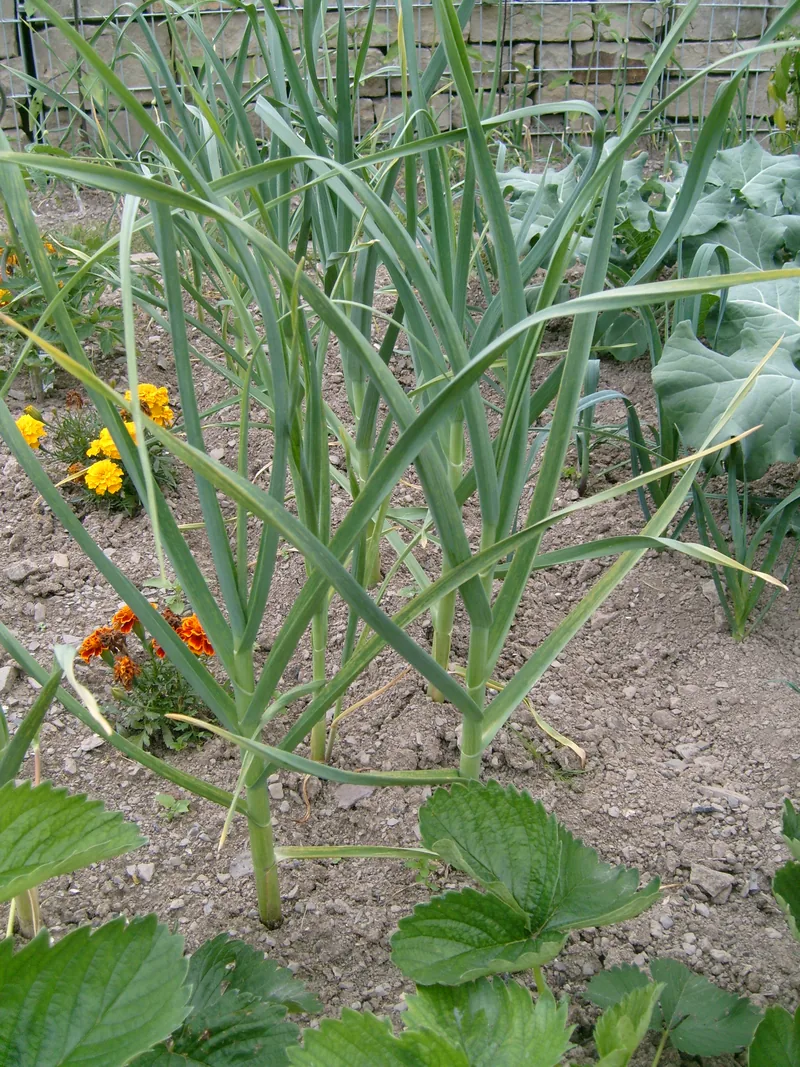
Cloves for planting, the RHS says, should be named varieties bought from a garden centre or mail-order supplier. It is not recommended to plant garlic bought from the supermarket, which may be unsuitable for the British climate and carries a risk of introducing disease. [RHS] Garlic is usually planted from mid-autumn to early winter, the RHS says, because most varieties need one to two months at 0–10°C (32–50°F) for good bulb development. Some varieties are suitable for planting in late winter and early spring. [RHS] Plant cloves the right way up, with the flat end downwards and the pointed end upwards, 15 cm (6 in) apart, with the tip 2.5 cm (1 in) below the soil surface, and with rows 30 cm (1 ft) apart. [RHS] If the soil is heavy or wet over winter, the RHS advises starting cloves in modules in autumn, keeping them in an unheated greenhouse, a cold frame or a sheltered outdoor spot, then planting them out in spring, 15 cm apart. [RHS] Garlic can be grown in a container; pots should be at least 25 cm (10 in) deep, at the same spacing and depth as in the ground. [RHS] Before planting, the RHS says to apply about two bucketfuls of well-rotted (not fresh) manure or homemade garden compost every square metre or yard, on a sunny site with free-draining soil. [RHS]
Through the growing months
To improve bulb size, water during dry spells in spring and early summer, the RHS says, but do not water once the bulbs are large and well formed, and try to avoid wetting the leaves. [RHS] Remove any flower stems as soon as they start to form, the RHS says, or the plant’s energy goes into the flower rather than swelling the bulb, and the bulb will not store well. If picked young, while the flower is still in bud, the flower stalks (scapes) can be cooked. [RHS] Cloves that form on the stalk, known as “top sets”, are usually due to changeable or fluctuating temperatures in spring, and can be used as you would ordinary cloves. [RHS]
Lift, cure, store
Bulbs are ready to harvest once the leaves have turned yellow. Autumn-planted garlic is ready from late spring to early summer, and spring-planted garlic from mid-summer to early autumn. Do not delay: bulbs lifted late tend to open up and have a shorter storage life. [RHS] Dry the bulbs thoroughly in a single layer in the sun — a well-ventilated greenhouse is ideal — but avoid excessive heat above 30°C (86°F). Initial drying takes two to four weeks, depending on the weather. [RHS] Once the foliage is dry and rustling, cut it off and store the bulbs in a cool, dry place at 5–10°C (41–50°F). Hardneck varieties can store well for four to six months; softneck varieties store for longer, potentially up to a year. [RHS] Bulbs that do not divide into cloves are usually the result of insufficient cold weather over winter, the RHS says. Split bulbs can happen if the crop was harvested late. Green cloves are usually due to shallow planting: they can be used as normal, but are unlikely to store well. [RHS]
The growing page and the lift and store page set the same record out in slightly longer form.