Home · Types
Types
Hardneck, softneck and elephant garlic
Two types of true garlic, and a bigger, milder bulb that is not garlic in the botanical sense.
There are two main types of garlic, the RHS says: hardneck and softneck. [RHS] Kew distinguishes two main types, or subspecies: hard-necked garlic (Allium sativum var. ophioscorodon) and soft-necked garlic (Allium sativum var. sativum). [Kew]
Hardneck
Hardneck garlic, on the RHS’s account, produces bulbs with fewer, larger cloves, has a stronger flavour, stores well for about four to six months, and is more prone to bolting (flowering), which can lead to a smaller bulb that will not store. [RHS] Every part of the garlic plant is edible, Kew says. The bulb is the part most often used; the flower stalks (scapes) and leaves are also sometimes used in cooking. [Kew]
Kew’s hard-necked garlic is Allium sativum var. ophioscorodon. The flower stalk — the scape — is the thing to snip, and then, if you like, to cook.
Softneck
Softneck garlic produces smaller, more tightly packed cloves, the RHS says, and stores for longer: autumn plantings keep well into the following winter, and spring plantings until the middle of the following spring. It is unlikely to bolt, except in poor growing conditions. [RHS]
Kew’s soft-necked garlic is Allium sativum var. sativum. These are the bulbs that often store the longest, and the ones whose dry leaves are sometimes plaited.
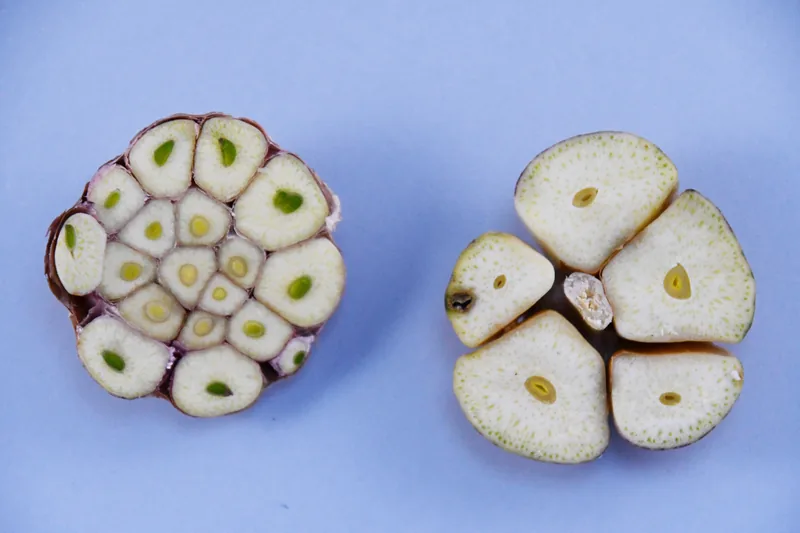
Elephant garlic is not true garlic
Elephant garlic (Allium ampeloprasum) is often sold as garlic, the RHS says, but is actually more closely related to leeks. It produces a big bulb with a small number of very large cloves, which have a mild flavour, and is best planted in October. [RHS] Elephant garlic sometimes does not divide into cloves, the RHS says, producing a large single-clove (solo) bulb. Early planting often reduces the occurrence of solo bulbs, which can be eaten or replanted the following autumn, when they will usually go on to produce a multi-clove bulb. [RHS] Garlic is in the genus Allium, Kew says, so it is closely related to onions, leeks and chives. [Kew]
The cross-section above is a credited photograph of a real garlic bulb beside a real elephant-garlic bulb, disclosed as a comparison, not a scale drawing of every variety.